
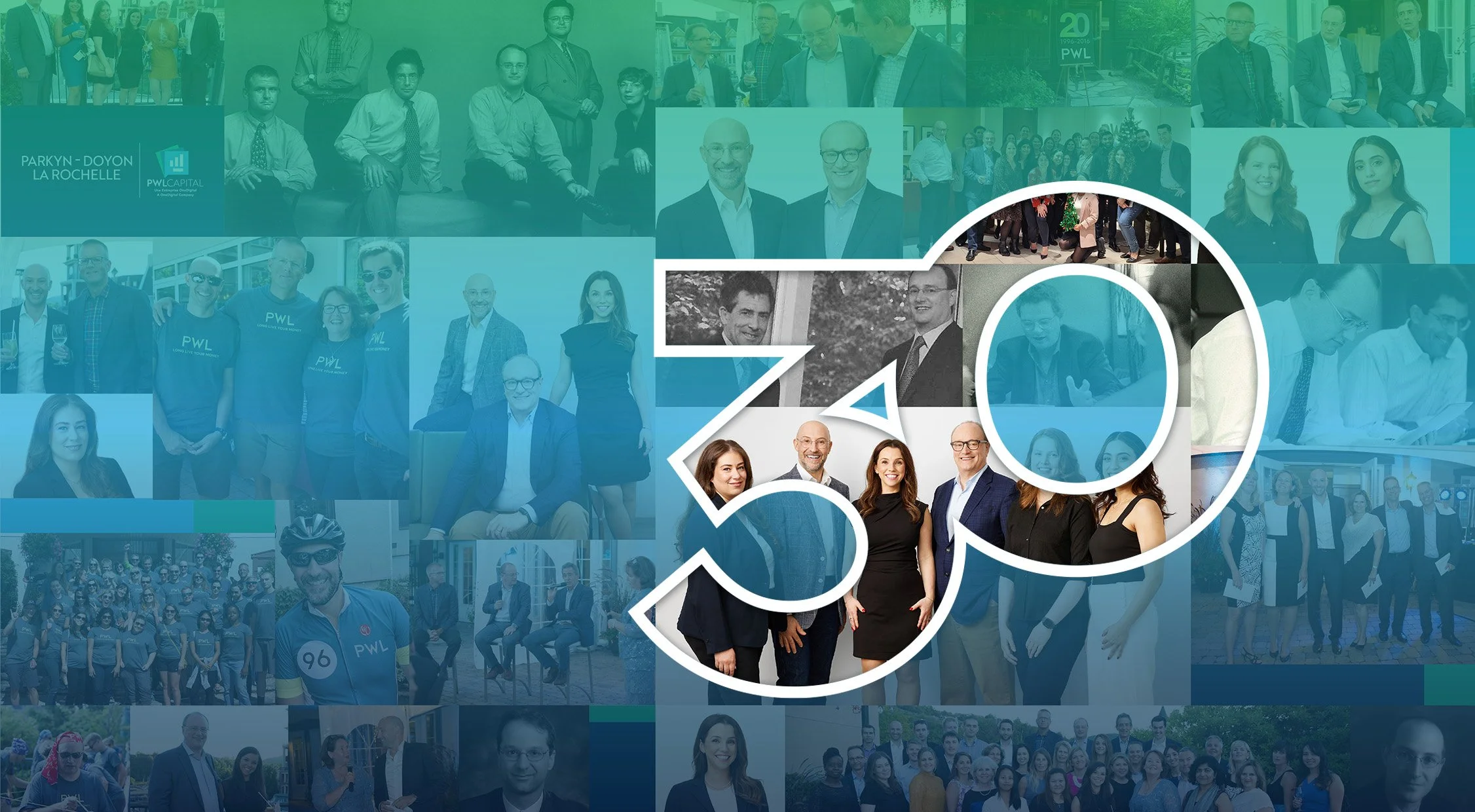
30 Years of Putting Clients First at PWL Capital
By James Parkyn - PWL Capital - Montreal
PWL Capital began 30 years ago with a clear vision. My two partners and I had an idea that we believed could reshape the wealth management industry in Canada.
We set out to build a new type of advisory firm—one without conflicts of interest and focused solely on clients.
PWL would offer fee-based wealth management, with no commissions or in-house products. At the time, this idea was far from mainstream. The vast majority of wealth managers were compensated through commissions. They focused on selling their firm’s products, and their incentives were often misaligned with those of clients.
We also wanted to bring together money management and financial planning under one roof. We’d create a true one-stop shop to help clients reach their goals. This was a big new idea.
Leading-edge firms in the U.S. had already moved in this direction. It was the way of the future. But no one else in Canada had adopted this approach yet. Financial planning and sound asset allocation were often given little more than lip service.
Investors deserved better
My partners Laurent Wermenlinger and Anthony Layton (the “W” and “L” in “PWL”) and I felt investors deserved better. We wanted to put clients first. Our approach would be based on clients’ needs and disciplined long-term investing.
PWL would hold itself to the highest standards of integrity, objectivity and expertise. With no conflicts, we could sit on the same side of the table as the people we served.
This carried through to how we reported performance results to clients. We adopted the standards of the Association for Investment Management and Research (now the CFA Institute). This was virtually non-existent in the retail wealth management space in Canada at the time.
Clients would easily be able to see how their investments were doing.
Pioneering approach vindicated
We believed there was an investor appetite for such a new approach. It turns out, we were right. PWL Capital quickly had $7 million under management soon after we opened our doors in 1996.
Our pioneering approach was vindicated. This, however, didn’t mean easy sailing. Despite our early success, the first years were challenging and uncertain. After paying rent and salaries, we didn’t have enough left over to pay ourselves as partners for several years.
PWL grew quickly, but costs did, too. We needed larger premises. We had to hire more staff. But we knew we had to invest in our business, even if the payoff took time. We had to create value for clients and develop an internal business culture. Targeting success too quickly also had its risks.
After four years, we reached our first $100 million in assets under management. We took our first steps at expansion in 1997 with an office in Ottawa, then another in Toronto in 2003.
I worked those first years non-stop. When I travelled across Canada and the U.S. for conferences, I thought of those trips as my “vacations.”
Enter the ETF
The financial markets brought their own set of challenges. The dot-com crash of 2000-2002 led to a drop in assets under management. But we learned from the experience, too. We saw something during the crash that shaped a new course for PWL: Active managers had failed to outperform.
This revelation led us to research and invest in exchange-traded funds (ETFs). These are low-fee, passively managed funds that replicate the holdings of various indexes instead of trying to beat them.
The idea was to own the entire stock market through index-based ETFs, which own all the stocks in a specific index, such as the S&P/TSX Composite Index.
While ETFs are well-known now, few investors had heard of them at the time. Many didn’t understand why we liked them. They thought it was like giving up. Some likened marketing passive investing with ETFs to entering the Olympics 5,000-metre race with a weight tied around your ankle.
Markets work
But evidence showed that stock picking and market timing were like gambling. These weren’t reliable ways to fully benefit from the market’s gains. Instead, we embraced the bold idea that markets work. Our goal would be to deliver the expected returns that markets have to offer.
As part of this evolution, we helped bring Dimensional Fund Advisors and their low-cost factor-based funds to Canada. Dimensional, in turn, helped us hone our philosophy of passive investing and, significantly, to develop the messaging on how to sell this new value proposition to clients. Dimensional became a key strategic partner in helping us develop our company based on global industry best practices.
We have been working with Dimensional since 2003, and they have excelled at identifying academic findings that can be implemented in the products that we use in our clients’ portfolios.
Dimensional’s discipline about managing portfolios based on academic science is a critical component of how we implement our approach of “buy, hold and rebalance.” This evidence-based approach is core to our success story and the long-term performance of clients’ portfolios.
Many shades of diversification
Other forms of diversification of course remain important, too. For example, U.S. stocks strongly outperformed Canadian and international counterparts for over a decade after the financial crisis ended in 2009. Yet, Canadian and international stocks flipped the story in 2025, paying off for investors with oversized gains.
Being broadly diversified within an asset class is also crucial. As economist Hendrik Bessembinder found in a key paper, just 4% of companies accounted for all U.S. stock market wealth creation above a risk-free T-bill investment from 1926 to 2023. The majority of stocks—51.6%—actually had negative compound returns during this period.
Being diversified between stocks and bonds also reduces risk. These two asset classes tend to have a negative correlation during crises, with bonds offering a cushion when stocks sell off.
Value of diversification
Such an approach also coincides with research showing the value of diversification across asset classes and countries. Owning a well-diversified portfolio of stocks and bonds reduces risk and increases returns, studies showed.
Our approach was to stay broadly invested and diversified regardless of any one market’s short-term ups and downs. This way we’d be sure to capture the total market’s winners over the long run and enjoy the incredible long-term gains it offered.
Our data-based choice has been repeatedly confirmed by new studies over the years. One remarkable study found that just 4% of stocks accounted for all U.S. stock market wealth creation above a risk-free investment in Treasury bills from 1926 to 2023.
A majority of stocks—51.6% to be exact—actually had negative compound returns. In other words, slightly more than half of stocks lost money over their life.
Fantastic gains come with a price
No one could know ahead of time which companies would be among those successful 4%. Owning the entire market was the only way to be sure to capture their gains. If you did so, you could make fantastic returns.
A dollar invested in a diversified international equity portfolio in 1970 would have grown to over $16 after inflation by 2024, PWL Capital Senior Researcher Raymond Kerzeho found in a report last year.
We recognized, however, that such amazing returns came at a price: volatility. This was the cost of entry for investing success. As Raymond found, the period since 1970 saw six bear markets (a 20%+ real decline). “Investors should hold on to their portfolio and expect bear markets as a normal part of investing,” he said. “These periods are the entry price to join the club of successful long-term investors.”
Most active funds underperform
The research has also only gotten clearer about actively managed funds. Studies have repeatedly confirmed our view that most active funds underperform the markets. In 2025, the annual SPIVA report found that a whopping 89% of actively managed multi-cap funds underperformed the S&P 500 Composite Index over the prior 20 years.
The long-term evidence is that only a small portion of stocks tends to deliver most of the wealth creation of the stock market. But there’s no way to know ahead of time which companies will be the winners.
As Warren Buffett once put it, “It’s harder than you would think to predict which will [companies] be the winners and losers. And those who tell you they know the answer are usually either self-delusional or snake-oil salesmen.”
Supporting clients’ prosperity
But our business was about more than managing portfolios. We saw our role more broadly as supporting clients’ overall prosperity and well being. A portfolio is a means to a bigger end—whether it be supporting a client’s financial needs, giving to charity or community projects, or leaving a legacy for the next generation.
Our first step with a new client is to sit with them to understand their overall goals, risk capacity and risk tolerance. We review everything from tax and estate planning to insurance needs and financial objectives. With this information, we develop an integrated plan, including any needed tax, estate and insurance advice.
The process allows us to craft and propose an investing strategy to meet our clients’ life goals. The strategy includes settling on a mix of stocks and bonds to ensure they have a level of volatility in their portfolio that lets them sleep at night during inevitable market selloffs. The bond allocation provides stability and a source of income during market downturns, reducing the need to sell equities at depressed prices.
Client education builds confidence
Our approach also involves coaching clients in investing. We place a strong emphasis on education. This helps customers feel confident in their strategy and maintain the discipline to stay the course through market volatility, while ignoring the noise from pundits and analysts.
This approach, too, is borne out by evidence. A study by the investment firm Vanguard found that advisors who use wealth management best practices can add up to 3% or more in net annual returns for clients. That added value compounds significantly over many years.
One of an advisor’s most significant contributions is coaching investors, the study found. During market swings, fear and euphoria can push investors toward rash actions that undermine their plans. A knowledgeable, experienced advisor can help clients hold steady when markets fall and avoid overconfidence when they rise.
PWL grew rapidly
Our approach resonated strongly with investors, and PWL grew rapidly. By 2007, we had $600 million in assets under management—nearly double the amount in 2003. Then the financial crisis of 2007–09 unfolded, hitting both investors and the firm hard. Assets declined to $460 million.
We tightened our belts and reduced compensation, not wanting to let any of our team go. Our employees are like family. We’re so proud of how many have built rewarding careers, started families and bought homes. They’re also invaluable for our work—without them, we can’t serve our clients. We’re very gratified that we were able to avoid layoffs and ride it out.
In a sense, we were putting our own philosophy into practice—remaining focused on the long term and navigating market volatility with discipline. We believed that markets would eventually recover and that our strong foundation positioned us well for what lay ahead.
Two new reasons to smile
There was also happy news. I became a father of twins. I couldn’t have been prouder, more excited or more optimistic. Fatherhood infused my work with new positive energy and hope.
During financial crises, portfolio managers tend to spend more time than usual speaking with clients about the markets. We need to explain the rationale behind their portfolio and reassure them about the benefits of sticking with their long-term strategy.
The financial crisis reinforced for us the importance of educating clients. We decided to extend that mission to the broader public. We saw a clear need for unbiased evidence-based guidance amid a flood of poor advice, unreliable forecasts and widespread investor stress.
Helping investors stay the course
In the early 2010s, our portfolio managers Justin Bender and Dan Bortolotti started to write investor blogs. They were later joined by Cameron Passmore and Ben Felix with the Rational Reminder podcast. The latter became one of Canada’s most widely recognized financial education platforms and most internationally successful podcasts on investing. Ben Felix also publishes a widely followed YouTube channel.
My team partner François Doyon La Rochelle and I also chimed in on a smaller scale with our “Capital Topics” podcast (“Sujet Capital” in French), which we started during the pandemic. I also launched my own blog in 2021.
Our content has reached millions of Canadians, positioned PWL as an industry leader and helped investors navigate the complexities of investing and market turbulence. Many PWL team members have sought careers at PWL based on our content.
Our publicly available advice mirrors the coaching we give clients. We’re proud of our efforts to help investors stay the course and maintain a disciplined long-term view. Those who managed to hold on through the selloffs have gone on to enjoy incredible returns.
Values set us apart
One study, which we wrote about in our Capital Topics blog, found that investors who stuck with a 50-50% stock-bond mix through the financial crisis saw a 209% return by 2024—versus a 16% loss for those who moved fully to cash.
To quote Warren Buffett again: “In the 20th century, the United States endured two world wars and other traumatic and expensive military conflicts; the Depression; a dozen or so recessions and financial panics; oil shocks; a flu epidemic; and the resignation of a disgraced president. Yet the Dow rose from 66 to 11,497.”
Through the years, PWL has given back in other ways. We support many charities, including United Way Centraide, university and hospital foundations, and other worthy charitable organizations. We believe our values set us apart.
The PWL difference
I couldn’t be more gratified or grateful when clients tell us they appreciate the PWL difference. We see the proof in our results. By 2014, we had our first $1 billion under management.
In 2016, we solidified PWL’s commitment to the highest standards by obtaining certification from the Centre for Fiduciary Excellence, an independent body that promotes best practices in the investment industry.
Assets under management grew to $2.5 billion in 2017 and $5.5 billion in 2025. That year, the Globe and Mail reported that PWL was one of Canada’s fastest-growing wealth management companies. Growth had averaged 17% annually over the previous decade, compared with an industry average of under 10%.
$8B assets—partnering with OneDigital
It’s also gratifying to see the investing industry embrace our approach. In 2025, we took a big step and partnered with Atlanta-based OneDigital. Under the agreement, PWL Capital remains as a stand-alone unit with resources available to accelerate our growth. Together we’re creating a firm with broader reach, deeper expertise and a larger platform, while staying true to the principles that made us successful.
In keeping with this evolution, we rebranded in February as PWL Capital, A OneDigital Company.
Assets under management today stand at $8 billion.
From upstart to industry leader—thank you!
As we celebrate PWL Capital’s 30th anniversary in 2026, I’m incredibly proud of our extraordinary story, values and mission of changing the investing world for clients by offering disciplined, evidence-based financial advice they can trust. I believe wholeheartedly in the values and mission of the firm.
We’ve grown from an upstart boutique advisory practice to one of Canada’s leading evidence-based wealth management firms. I’m very grateful to our OneDigital partners, our highly talented team, my partner François Doyon La Rochelle, and our dear clients who believe in us and have helped fuel our remarkable growth. Heartfelt thanks for your great contributions and for sharing our vision.
I’m excited for the new chapters of PWL and what we accomplish next. We wish our customers, team and partners happiness, health and success in your endeavours.
Find commentary on personal finance and investing, our podcast, past blog posts, eBooks, model portfolios and market statistics on the website of PWL Capital’s Parkyn-Doyon La Rochelle team and our Capital Topics website.